


Vibe coding a budgeting tool. Drafting an email to a landlord. Researching flights for a trip. Troubleshooting a disconnected Wi-Fi router. Conversational AI chatbots have become ubiquitous for these daily tasks and more.
But perhaps surprisingly, coding, writing, research, and troubleshooting aren’t even the most common personal use cases of AI. According to a Harvard Business Review analysis digging into how people actually use AI in their personal lives, “therapy and companionship” top the ranking and have for the past two years. Close behind are “relationship advice” and “work-related emotional issues.”
People aren’t just asking AI to get things done, but increasingly to help them think things through, feel less alone, and provide support. It is a real and growing need, but the tools people are turning to are not purpose-built for the job.
While standard large language models (LLMs) can hold a decent conversation, they are known to be sycophantic, affirming any input. For casual exchanges, that tendency is typically harmless. But when people turn to AI for support through the full range of life’s experiences, constant affirmation fails to build psychological fitness, and it can even be harmful.
Psychological fitness is the set of capacities that helps people navigate challenges: build strong relationships, recover from setbacks, find purpose, and move through life with greater resilience and agency. Just as physical fitness is about building capabilities rather than treating an injury, psychological fitness is about developing inner resources instead of treating a condition.
To enhance our psychological fitness, sometimes we need agreement, and sometimes we need pushback or redirection. For human counselors, these choices are obvious, but current AI models are not particularly emotionally intelligent — they can’t perceive what a person needs, understand it in the context of their life, or choose the response that will serve them best.
Can we build a technology to help people be psychologically fit and flourish — not simply avoid distress, but function well across all areas of their lives? It’s a nuanced question, and therefore a challenging engineering problem.
This is the focus for iris labs, a Flagship-founded company developing iris chat, a new type of AI that is designed to help people improve psychological fitness. Iris chat is helping people find perspective, get unstuck, connect with others, and confidently take their next steps out in the world.
But building this new AI has required solving problems that most LLMs have never considered. To engage successfully, iris chat must understand someone as a dynamic, socially embedded human being. It needs to carry context forward over time and determine when to listen, when to challenge, when to redirect, and how to do each safely. Achieving this has required advances across several areas of AI, including two that are particularly important: self-learning and safety.
Teaching AI to learn from itself when there’s no clear “right” answer
AI systems often rely on self-learning loops that improve as they gather more data without human training. Over time, this skill has become relatively easy in objective domains. An AI can learn games like chess or Go because there is an unambiguous measure of success, meaning it either wins or loses. It can repeatedly play, learn which decisions lead to victory, and improve. But self-learning is infinitely more challenging when dealing with subjective areas, like human emotions.
For iris chat, we had to ask: How can iris learn to empathize with a user to promote emotional processing and growth without reinforcing problematic interpretations, behaviors, or outcomes? This is a highly complex problem, and a task that gives general-purpose LLMs significant trouble.
Emotionally intelligent LLMs like iris chat rely on well-crafted AI coaches, AI agents designed to evaluate the output of other agents, providing constant and consistent optimization loops for nuanced social interactions. AI coach performance is critically important for the overall performance of the LLM.
To craft a high-performing AI coach, iris labs first asked a world-class expert to encode decades of experience and intuition into instructions and guidance for the LLMs, creating a human-expert authored AI coach (Figure 1, gray bar). The team then applied a self-learning loop to the human expert coach, systematically testing, scoring, and refining those expert-written instructions. The result was a 38% improvement over the instructions produced by the expert alone (Figure 1, green bar).
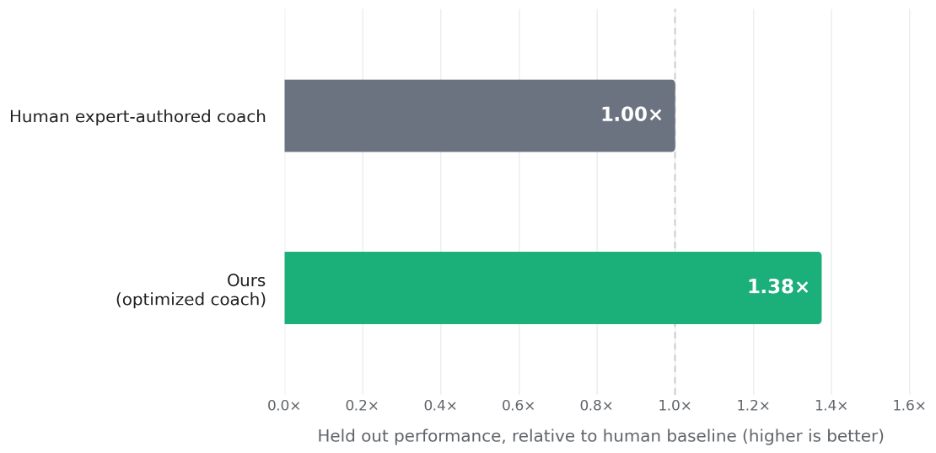
This is an exciting result because it shows that, as self-learning improves in subjective domains, it can be used to amplify human expertise and push performance beyond what even world-class experts can achieve on their own. By combining deep domain knowledge with the iterative learning capabilities of LLMs, iris labs can build AI coaches that outperform even carefully crafted expert guidance, and continue improving from there.
Ultimately, this translates into a better experience for users by crafting responses that are more nuanced, more context-aware, and more likely to support meaningful emotional processing and growth.
Instilling an understanding of user safety
AI coaches give iris chat a powerful way to evaluate and improve AI behavior for the purposes of psychological fitness. But while they augment human guidance, for iris chat, they never replace it entirely. This is especially important when it comes to safety. Iris labs designed its safety system so that AI can assess and respond to situations in real time, while human experts remain in the loop to review the most sensitive interactions, helping refine how it behaves over time.
As more people turn to AI in moments of real vulnerability, the cost of a model responding poorly is severe. Getting this right requires the AI to develop situational awareness it doesn’t inherently possess. In other words, AI must understand the world and unique situations, not just language.
Responding appropriately as conversations become more sensitive is a distinct technical challenge. Today, most LLMs default to being overly cautious. That can look like abruptly shutting down a conversation or directing someone to crisis resources, even when such a response is not necessary.
To be useful, it’s important for a tool like iris chat to be supportive while not being unnecessarily restrictive. Overreacting can inadvertently shut down a conversation while leaving people without meaningful support in the moments they need it most. Simply refusing to engage is not necessarily better: research suggests that disengaging from users in difficult moments can leave them feeling more isolated or distressed.
Iris labs has developed a robust parallel safety agent that operates in tandem with iris chat to ensure conversations are handled with the utmost care and respect. This system reviews the context of a conversation, guiding iris as needed and allowing for more sophisticated responses.
The diagram in Figure 2 shows this system in action. When a user sends a message to iris chat, the parallel safety agent analyzes the message’s context according to provided guidance, rules, and criteria. If the message is deemed routine, no additional guidance is provided and iris chat is free to engage the user with its core guardrails in place.
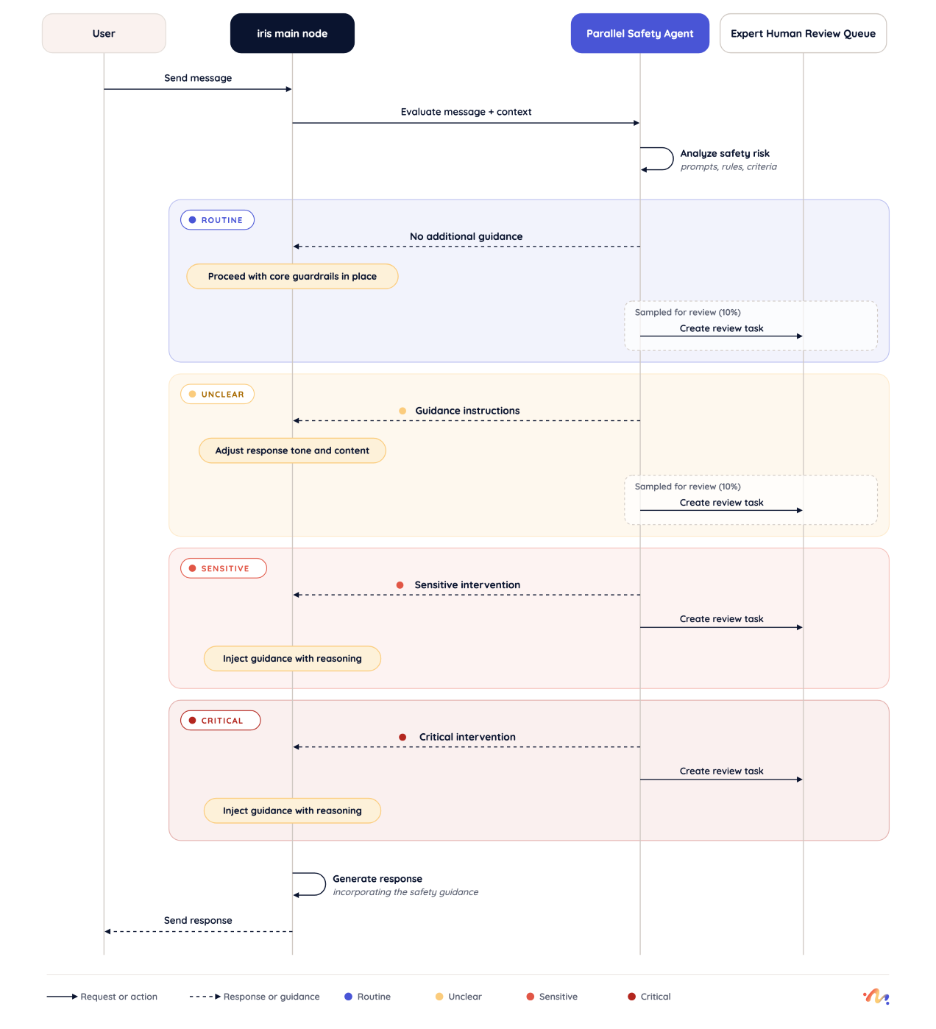
However, when iris chat receives a message deemed as sensitive or critical, the safety agent helps shape iris chat’s response. When layered with iris chat’s long-term memory, this can look like encouraging users to lean on specific people and resources around them.
But interpreting tone from a written message is not always black or white. Anyone who has misunderstood the tone of a text message or email knows how easily meaning can be lost without the context of a voice, facial expression, or body language. A message that initially seems concerning may have a very different meaning in context, and vice versa. To account for this, the safety agent can prompt iris chat to safely clarify a user’s intent before determining the appropriate response. This additional step helps the system interpret the intended tone more accurately, avoiding overreaction while still allowing it to respond thoughtfully when someone needs support.
Human review closes the loop. Expert assessments of a range of interactions provide feedback that can be used to refine the safety agent’s criteria over time, allowing the self-learning system to become more discerning without removing humans from the process.
This unique approach to safety has resonated with users, demonstrating a notably higher 30-day retention of users compared to industry averages.
Where to next?
It’s clear that the opportunity for conversational AI is much bigger than just making people more productive. When you can thoughtfully build AI in ways that are genuinely useful, you open up an entirely different possibility for how this technology can be used.
Knowing when to affirm, when to challenge, when to clarify, and when and how to intervene have historically been left to human judgment. But that doesn’t mean AI is inherently incapable of making those distinctions. It means we have not yet built systems designed to do so well.
That’s not to say it’s easy to do. Advances in self-learning are an early example of the significant technical progress required to build that kind of emotional intelligence into AI.
But if we can get these systems right, AI could become more than a productivity tool. It could become a new layer of trustworthy support, helping people build the psychological fitness to navigate what’s hard, create more of what’s good, and flourish.